|
Geometry and Quantum Theory
|
|

|
Finite Geometries Behind Hilbert Spaces
Slovak head of project: Metod Saniga
Astronomický ústav
Slovenská akadémia vied
Tatranská Lomnica
Slovakia
Austrian head of project: Hans Havlicek
Supported by the Slovak and Austrian Governments
(Aktion Slowakei - Österreich), project number 58s2, 2007-2008.
|

|
Finite Projective Ring Geometries:
An Intriguing Emerging Link Between Quantum Information Theory, Black-Hole Physics, and Chemistry of Coupling
Cooperation group at the Centre for Interdisciplinary Research, University of Bielefeld (Germany)
August 1st to October 31st, 2009.
Principal Organiser: Hans Havlicek, Vienna University of Technology, Austria
Co-Organiser: Metod Saniga, Astronomical Institute of the Slovak Academy of Sciences, Tatranská Lomnica, Slovakia
Further Information
|

Astronomical Institute, Slovak Academy of Sciences
|
Finite Ring Geometries: Where Qudits meet Black Holes
Slovak head of project: Metod Saniga,
Astronomický ústav,
Slovenská akadémia vied,
Tatranská Lomnica,
Slovakia
Austrian participants: Hans Havlicek (head) and Boris Odehnal.
Supported under the Slovak-Austrian Science and Technology Cooperation Agreement under grants SK 07-2009 (Austrian side) and SK-AT-0001-08 (Slovak side), 2009-2010.
|

|
Finite-Geometrical Aspects of Quantum Theory
Principal Investigator: Metod Saniga (Lise Meitner research fellowship)
Co-applicant: Hans Havlicek
Supported by the Austrian Science Fund (FWF - Fonds zur Förderung der Wissenschaftlichen Forschung), project M-1564-N27, 2014-2015.
Workshop
-
Vienna University of Technology, February 23-27, 2015
Poster (PDF)
|
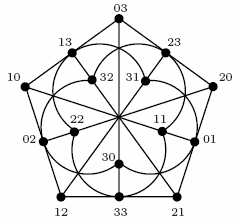
The smallest generalised quadrangle
|
Two-qubits and the smallest generalised quadrangle
M. Saniga and M. Planat discovered in 2006 that completely new vistas open up if, instead of dealing with a given Hilbert space itself, one considers the associated space of generalised Pauli operators/matrices. They demonstrated that the operators' space characterising the simplest non-trivial systems, so-called two-qubits, is isomorphic to the generalised quadrangle of order two.
The the generalised quadrangle of order two is a point-line geometry with 15 points and 15 lines. Each point is on 3 lines and, dually, also each line is incident with 3 points. Collinear points correspond to commuting operators.
Generalisations
Some steps to generalise the above Saniga-Planat Theorem have already been taken, thereby establishing a relationship to symplectic polar spaces (K. Thas).
We aim at further generalisations of this theorem to systems of N-qudits for arbitrary numbers N and d. Here the projective line over the ring of integers modulo d plays a prominent role.
Further Information
Visit the web site of Metod Saniga (external link).
|
|
|
Publications
-
H. Havlicek and K. Svozil: Density conditions for quantum propositions, J. Math. Phys. 37 (11) (1996), 5337-5341.
Preprint (PDF)
-
H. Havlicek, G. Krenn, J. Summhammer, and K. Svozil: Colouring the rational quantum sphere and the Kochen-Specker theorem, J. Phys. A 34 (2001), 3071-3077.
Preprint (PDF)
-
M. Saniga, M. Planat, P. Pracna, and H. Havlicek: The Veldkamp-space of two-qubits, SIGMA Symmetry Integrability Geom. Methods Appl. 3 (2007), paper 075, 7 pp. (electronic).
Preprint (PDF)
-
H. Havlicek and M. Saniga: Projective ring line of a specific qudit, J. Phys. A 40 (2007), F943-F952.
Preprint (PDF)
-
H. Havlicek and M. Saniga: Projective ring line of an arbitrary single qudit, J. Phys. A 41 (2008), Article ID 015302, 12 pp.
Preprint (PDF)
-
M. Saniga, H. Havlicek, M. Planat, and P. Pracna: "Twin Fano-Snowflakes" over the smallest ring of ternions, SIGMA Symmetry Integrability Geom. Methods Appl. 4 (2008), paper 050, 7 pp. (electronic).
Preprint (PDF)
-
H. Havlicek, B. Odehnal, and M. Saniga: Factor-group-generated polar spaces and (multi-)qudits, SIGMA Symmetry Integrability Geom. Methods Appl. 5 (2009), paper 096, 15 pp. (electronic).
Preprint (PDF) | Article (PDF, external link)
-
H. Havlicek, B. Odehnal, and M. Saniga: Möbius pairs of simplices and commuting Pauli operators, Math. Pannonica 21 (2010), 115-128.
Preprint (PDF)
|
|
Quick Links
ZiF Cooperation Group 2009
Chain Geometry
Design Theory
Hans Havlicek
Boris Odehnal
Sitemap
External Links
Metod Saniga, Slovak Academy of Sciences
Karl Svozil, Institute of Theoretical Physics, Vienna University of Technology

Centre for Interdisciplinary Research, Bielefeld, Germany
|
