|
Welcome to the research group
Differential Geometry and Geometric Structures
|
|
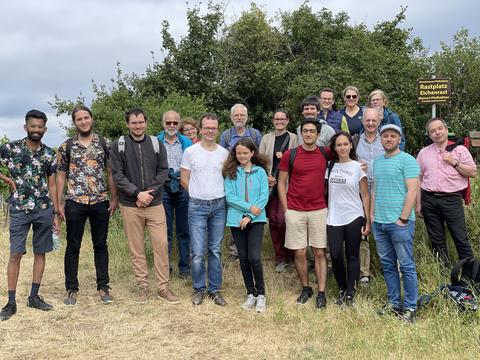
Members & friends of the group in Jul 2021
photograph © by Narges Lali
|
Differential geometry has been a thriving area of research
for more than 200 years, employing methods from analysis
to investigate geometric problems. Typical questions
involve the shape of smooth curves and surfaces and the
geometry of manifolds and Lie groups. The field is at
the core of theoretical physics and plays an important
role in applications to engineering and design.
Finite and infinite geometric structures are ubiquitous
in mathematics. Their investigation is often intimately
related to other areas, such as algebra, combinatorics or
computer science.
These two aspects of geometric research stimulate and
inform each other, for example, in the area of "discrete
differential geometry", which is particularly well suited
for computer aided shape design.
|
|
Gallery of some research interests and projects
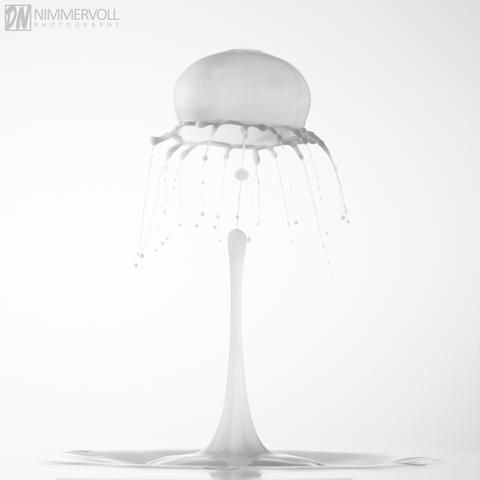
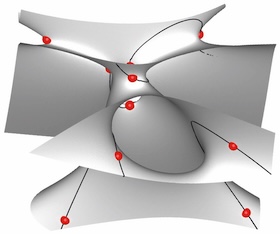
Symmetry breaking in geometry:
We discuss a geometric mechanism that may,
in analogy to similar notions in physics,
be considered as "symmetry breaking" in geometry.
(Fuchs, Hertrich-Jeromin, Pember;
Fig ©Nimmervoll)
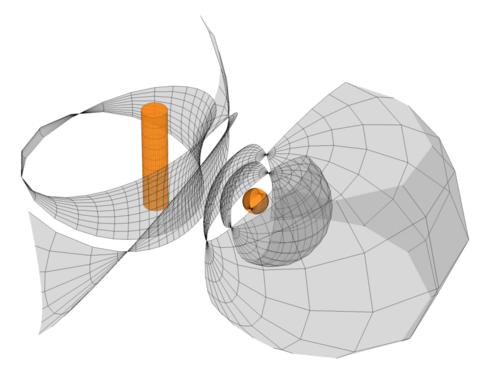
Cyclic coordinate systems:
an integrable discretization in terms of a discrete flat
connection is discussed.
Examples include systems with discrete flat fronts or
with Dupin cyclides as coordinate surfaces
(Hertrich-Jeromin, Szewieczek)
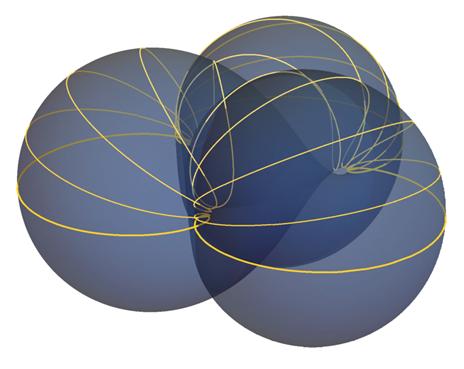
We study surfaces with a family of
spherical curvature lines
by evolving an initial spherical curve through
Lie sphere transformations,
e.g., the Wente torus
(Cho, Pember, Szewieczek)

Discrete Weierstrass-type representations
are known for a wide variety of discrete surfaces classes.
In this project, we describe them in a unified manner,
in terms of the Omega-dual transformation applied to
to a prescribed Gauss map.
(Pember, Polly, Yasumoto)
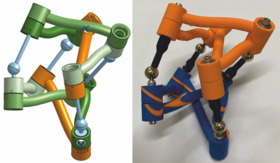
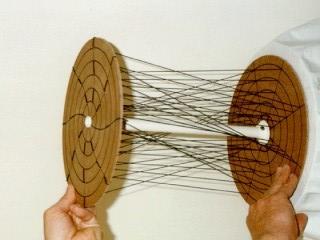
Billiards:
The research addresses invariants of trajectories of a
mass point in an ellipse with ideal physical reflections
in the boundary. Henrici's flexible hyperboloid paves the
way to transitions between isometric billiards in ellipses
and ellipsoids (Stachel).
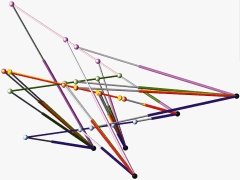
Spreads and Parallelisms:
The topic of our research are connections among spreads
and parallelisms of projective spaces with areas like
the geometry of field extensions, topological geometry,
kinematic spaces, translation planes or flocks of quadrics.
(Havlicek)
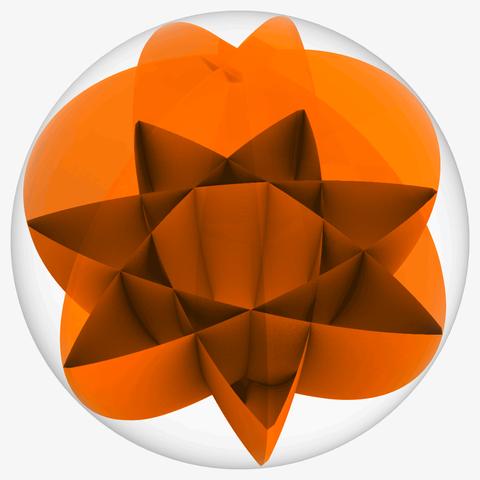
This is a surface of (hyperbolic) rotation in hyperbolic
space that has constant Gauss curvature,
a
recent classification project.
(Hertrich-Jeromin, Pember, Polly)
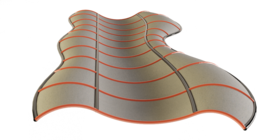
Geometric shape generation:
We aim to understand geometric methods to generate
and design (geometric) shapes,
e.g., shape generation by means of representation formulae,
by transformations, kinematic generation methods, etc.
(Hertrich-Jeromin, Fig Lara Miro)
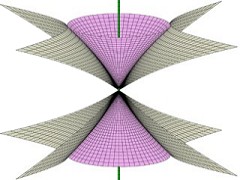
Affine Differential Geometry:
In affine differential geometry a main point of research is
the investigation of special surfaces in three dimensional
affine space.
(Manhart)
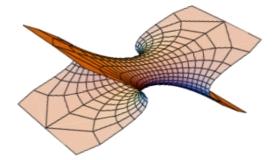
Transformations & Singularities:
We aim to understand how transformations of particular
surfaces behave (or fail to behave) at singularities, and
to study how those transformations create (or annihilate)
singularities.
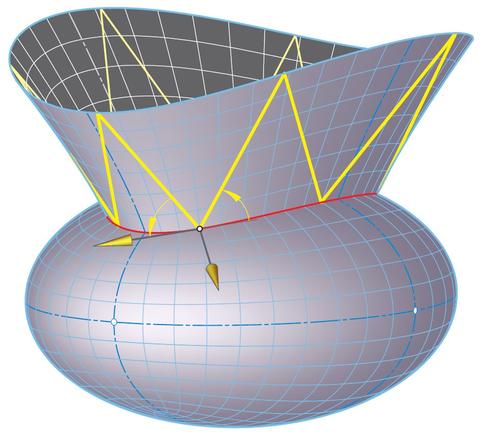
The figure shows the isothermic dual of an ellipsoid,
which is an affine image of a minimal
Scherk tower.
(Hertrich-Jeromin)
|
|
News
- 14-18 Jun 2027, TU Wien
- Conference on Geometry: Theory and Applications
(CGTA 2027)
Abstract
The Conference on Geometry: Theory and Applications (CGTA 2027)
is part of an (approximately) biannual conference series.
It is an international forum for presenting new trends and
results in theory, techniques, and applications of geometry.
More information at the conference web page
- 19 Oct 2026, 12:15 CEST: JA, surfaces and beyond
- Kaoru Iino (Yokohama National University):
Intrinsic invariants of (3,4)-cuspidal edges
Abstract
$(3,4)$-cuspidal edges are important singularities
that arise naturally on parallel surfaces of regular
surfaces, such as ellipsoids. For ordinary cuspidal edges,
Saji-Umehara-Yamada introduced the singular curvature
as an intrinsic invariant of cuspidal edges, and showed,
in particular, that its sign describes the local convexity
of cuspidal edges. On the other hand, for $(3,4)$-cuspidal
edges, the sign of the singular curvature is not canonically
well-defined, so different invariants are needed.
In this talk, we introduce two intrinsic invariants for
$3$-type edges, a class of singularities that includes
$(3,4)$- and $(3,5)$-cuspidal edges. We show that these
invariants describe the local convexity of $(3,4)$-cuspidal
edges. Moreover, using these invariants, we give a necessary
and sufficient condition for the boundedness of the Gaussian
curvature. We also obtain intrinsic criteria for generic
$(3,4)$- and $(3,5)$-cuspidal edges.
- 09 Oct 2026: Geometry seminar
- Ander Chocarro Salaberria (DTU):
Mathematics of surface stackability
Abstract
Surface rationalization and segmentation is often
unsatisfactory in architectural workflows, which can lead to
practical shortcomings such as inefficient packing and material
waste. We present a directional approach to the general problem
of stackability, namely the segmentation of architectural
elements into components that can be conveniently arranged into
physical stacks. Moreover, especially relevant surface classes
with desirable stackability properties are investigated.
- 22 Jul 2026, 12:00 CEST: JA, surfaces and beyond
- Naoya Suda (Kobe University)
Bäcklund transformations of K-surfaces
via Darboux matrices in smooth and discrete settings
Abstract
Surfaces of constant negative Gaussian curvature in
$3$-dimensional Euclidean space (hereafter abbreviated as
$K$-surfaces) admit an integrable equation known as the
sine-Gordon equation, and have been studied from the
perspectives of both integrable systems and differential
geometry. Furthermore, the existence of Bäcklund
transformations, which construct a new $K$-surface from a given
one, is an important property of $K$-surfaces, and the use
of Darboux matrices is well known as one of the algebraic
computation methods for these transformations. Meanwhile,
Bobenko and Pinkall (1996) and Hoffmann and Sageman-Furnas
(2016) each clarified the discretization of $K$-surfaces
and their algebraic computation methods based on different
coordinate systems. In this talk, we discuss the computation
methods for Bäcklund transformations using Darboux
matrices, comparing the smooth and discrete cases. Part
of this presentation is based on joint work with Thomas
Raujouan (University of Tours) and Wayne Rossman (Kobe
University).
- 23 Jun 2026: Bachelor Seminar im Dissertantenzimmer (UF DG, in Deutsch)
-
09:15 V A Horak: Möbius-geometrische Symmetrien in einem euklidischen Dreieck
10:15 L Reisinger: Vom Parallelenproblem zur hyperbolischen Geometrie
11:15 B Szabo: Hopffaserung
Abstracts
Möbius-geometrische Symmetrien in einem euklidischen Dreieck:
Gesucht werden Symmetrien zwischen den
Eckpunkten eines Dreiecks und dessen In- und
Ankreismittelpunkten. Tatsächlich lassen sich mithilfe
der Möbius-Geometrie acht Abbildungen finden, die
diese Punkte und den Punkt Unendlich aufeinander abbilden -
obwohl Mittelpunkte Möbius-geometrisch nicht mit deren
Kreisen zusammenhängen. Eine dieser Abbildungen, die
Antipodenabbildung, wird im Detail vorgestellt und anhand
von Visualisierungen veranschaulicht.
Vom Parallelenproblem zur hyperbolischen Geometrie:
Über zweitausend Jahre lang wurde Euklids
Parallelenpostulat, das nicht in die Reihe der anderen
passte, immer wieder hinterfragt. Der Vortrag zeichnet
nach, wie Janos Bolyai und Nikolai Lobatschewski im 19.
Jahrhundert die Frage umdrehten. Sie behandelten die Negation
des Postulats nicht länger als Fehler, sondern als
Ausgangspunkt einer eigenständigen Geometrie. Im Zentrum
stehen die mathematischen Ergebnisse ihrer Arbeit und die
Frage, warum diese neue Geometrie erst spät Teil der
wissenschaftlichen Debatte wurde.
Hopffaserung:
Die Hopffaserung ordnet Punkten der $2$-Sphäre Kreise
der $3$-Sphäre zu, wobei Quaternionen eingesetzt
werden. Mithilfe der stereographischen Projektion werden
Bilder der Fasern erzeugt. Auch die Bewegung entlang
einer Hopffaser wird visualisiert, wobei die doppelte
Überlagerung von $\mathrm{SO}(3)$ erkennbar wird.
- 18 Jun 2026: Geometry seminar
- Eleni Pachyli (TU Wien):
Lichnerowicz-Obata Theorem for the discrete spherical Laplacian,
in dimension two
Abstract
The classical Lichnerowicz-Obata Theorem states that for an
$n$-dimensional Riemannian manifold $(M,g)$ with $Ric \geq
(n-1)g$, the first eigenvalue of the Laplacian is greater or
equal than $n$. We prove a discrete analogue of this theorem in
dimension 2, for a spherical cone metric with curvature
$\kappa_i := 2\pi-\omega_i >0$ for the discrete spherical
Laplacian defined by I. Izmestiev and W. Lam. Our proof draws on
ideas from the theory of mixed volumes, in particular from Y.
Shenfeld and R. van Handel's proof of the Alexandrov-Fenchel
inequality. In the process, we also derive a discrete analogue
for the Bochner method.
- 17 Jun 2026, 12:00 CEST: JA, surfaces and beyond
- Keita Takahashi (Institute of Science Tokyo)
Completeness conditions for globally hyperbolic spacetimes
Abstract
In this talk, we discuss several completeness conditions
for globally hyperbolic spacetimes within the framework
of low-regularity settings. These conditions, originally
introduced by Busemann and Beem, serve as Lorentzian analogues
to those found in the classical Hopf-Rinow theorem. As a
related result, we explain an approximation theorem for the
space of Cauchy hypersurfaces, a space whose properties have
recently been investigated by Lange and Peteranderl.
- 11 Jun 2026: Geometry seminar
- Ivan Izmestiev (TU Wien): Discrete Wirtinger inequality
Abstract
The classical Wirtinger inequality compares the $L_2$-norm of a
periodic function with zero average with the $L_2$-norm of its
derivative. It was used by Hurwitz to give a new proof of the
isoperimetric inequality for smooth curves. A discrete version
of the Wirtinger inequality is due to Fan, Taussky, and Todd. In
this talk a generalization of the Fan-Taussky-Todd inequality
will be stated and proved.
- 03 Jun 2026, 12:00 CEST: JA, surfaces and beyond
- Shintaro Akamine (Nihon University):
Constant mean curvature surfaces in the three-dimensional light cone
Abstract
Some classes of surfaces in spaces equipped with degenerate
metrics often arise in correspondence with minimal surfaces
in Euclidean space and maximal surfaces in Lorentz-Minkowski
space. In this talk, we present local and global properties
of spacelike constant mean curvature surfaces in the
three-dimensional light cone. In particular, we explain
Bernstein-type theorems for such surfaces. This talk is
based on the joint work with Wonjoo Lee (Jeonbuk National
University) and Seong-Deog Yang (Korea University).
- 28 May 2026: Geometry seminar
- Darius Imre (TU Wien):
Die Geometrie der Addition und Multiplikation
Abstract
In diesem Vortrag konstruieren wir, ausgehend von einer
Menge von Punkten, Geraden und einer Inzidenzrelation, die
zusammen eine projektive Ebene bilden, eine Addition und eine
Multiplikation. Dazu untersuchen wir einige Eigenschaften von
Homologien und Elationen und verwenden diese anschliessend zur
Konstruktion eines Schiefkörpers. Dabei werden wir sehen,
dass die Existenz der dafür benötigten Abbildungen nur in
desarguesschen Ebenen garantiert ist. Abschliessend betrachten
wir die erweiterte euklidische Ebene und zeigen, dass der
dort entstehende Schiefkörper isomorph zu
den reellen Zahlen ist.
|

 Technische Universität Wien